Tag: Inflation

The 10 Biggest Financial Mistakes That Can Keep You From Building Wealth – Part 1 (Ep. 68)

The 10 Biggest Financial Mistakes That Can Keep You From Building Wealth – Part 1 (Ep. 68)

You can build a successful career, earn a high income, and still wonder why you’re not building lasting wealth. If you’re thinking about how to grow your investments, how much cash you should keep, or whether you’re taking the right amount of investment risk, the answer may have less to do with the market and more to do with the financial habits behind your decisions.

In this episode, John and Alex Soutsos discuss the first five financial mistakes that can keep physicians, business owners, and other high-income professionals from building long-term wealth. They explain why earning more doesn’t automatically create wealth, why compound growth and compound interest reward people who start investing early, why over-diversification can create unnecessary complexity, how inflation affects the purchasing power of cash, why longevity may be a greater financial risk than stock market volatility, and why tax planning should support your investment strategy instead of driving your financial decisions.

John and Alex discuss:

  • Why earning a high income doesn’t automatically build wealth, and why saving is the foundation of long-term financial growth.
  • How compound growth rewards people who start investing earlier, even if they contribute less over time.
  • Why over-diversification and using multiple investment firms can add complexity without meaningfully reducing investment risk.
  • Why holding too much cash can reduce purchasing power over time as inflation quietly erodes its value.
  • Why longevity, not short-term stock market volatility, may be the greatest financial risk during retirement planning.
  • Why tax planning should support your investment strategy instead of becoming the primary driver behind financial decisions.
  • And more!

Connect with Med-Wealth Financial Services: 
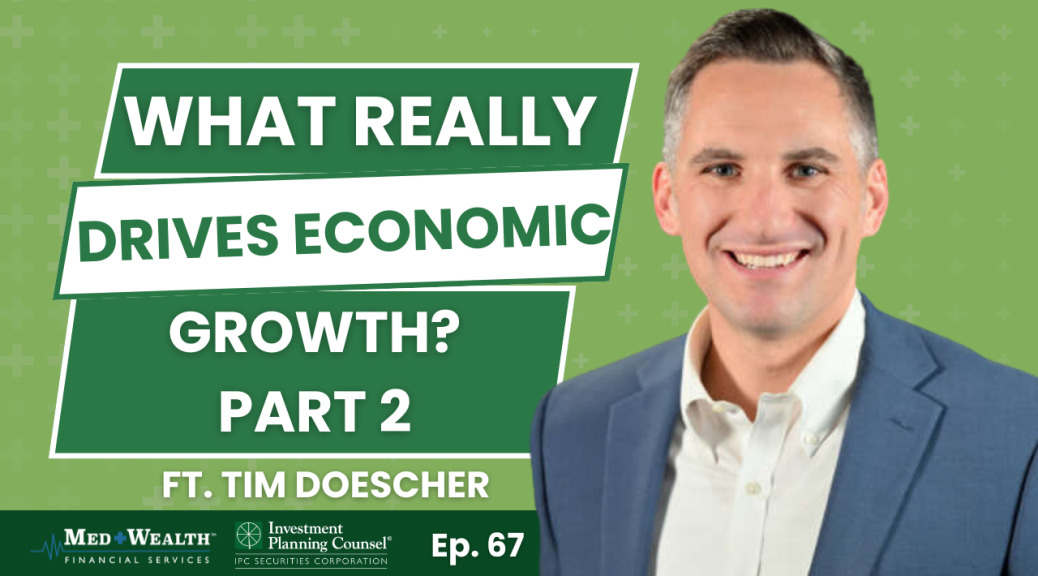
What Really Drives Economic Growth? with Tim Doescher – Part 2 (Ep. 67)

What Really Drives Economic Growth? with Tim Doescher – Part 2 (Ep. 67)

What actually drives economic growth, and what happens when governments try to control it?

In this episode, John and Alex Soutsos continue their conversation with Tim Doescher, diving deeper into the real-world impact of economic policy, from Reagan-era tax cuts to today’s debates around tariffs, inflation, and central banking.

John and Alex discuss:

  • A breakdown of supply-side economics and why it gained traction during the Reagan administration
  • How modern monetary theory abandoned empirical evidence to justify government spending, debt, and inflation
  • Why tax systems matter, including the case for a flat tax and the unintended consequences of complex tax codes
  • The reality of tariffs in a global economy, including trade tensions with China, and the balance between fairness and free markets
  • The future of the Federal Reserve, including Kevin Warsh’s potential leadership and what it could mean for interest rates, inflation, and economic growth
  • And more.

Resources:

Connect with Med-Wealth Financial Services: 
Connect with Tim Doescher:

About Our Guest: 

Tim Doescher is the Executive Director at Unleash Prosperity, a policy organization focused on advancing free market economic principles. With a background in political campaigns, public policy, and economic research, Tim works closely with leading economists and policymakers in Washington, D.C., helping shape conversations around taxation, regulation, and economic growth.

When Geopolitics Moves Markets: Oil, Conflict, and Investor Perspective (Ep. 63)

When Geopolitics Moves Markets: Oil, Conflict, and Investor Perspective (Ep. 63)

When markets become volatile, and headlines grow louder, how should investors respond?

In this episode, John and Alex Soutsos unpack what recent geopolitical tensions, oil price spikes, and economic headlines really mean for investors and why maintaining perspective matters more than reacting to the news cycle. They discuss how global events, including geopolitical conflict and shifting economic policy, can create uncertainty in financial markets, and how disciplined investors can navigate these environments without losing sight of long-term strategy.

John and Alex discuss:

  • Why markets tend to react negatively to uncertainty and what the recent volatility actually revealed beneath the surface of the S&P 500
  • How geopolitical events, including conflict in the Middle East, can influence market sentiment, energy prices, and short-term market movements
  • The relationship between oil prices, global supply disruptions, and how different economies are impacted by energy shocks
  • Inflation trends, tariffs, and why economic data may tell a different story than the one often presented in headlines
  • Potential changes in Federal Reserve leadership and what a shift in economic philosophy could mean for interest rates and market conditions
  • Why trade relationships between Canada and the United States remain critical to the Canadian economy and long-term economic stability
  • And more!

Connect with Med-Wealth Financial Services: 
History of Money – Part 1 (Ep. 47)

History of Money – Part 1 (Ep. 47)

The story of central banking is one of evolving intentions, unintended consequences, and ongoing debates about control, risk, and fairness in the economy.

In this episode, John and Alex Soutsos trace the history, evolution, and unintended consequences of central banking from Alexander Hamilton’s 1791 blueprint to Jerome Powell’s inflation dilemma today.

With wit and clarity, they explain how central banks were designed to prevent bank runs and create stability, but instead may be fueling business cycles, moral hazard, and widening wealth gaps. You’ll also hear how fiscal policy, political interference, and emergency bailouts have reshaped the role of the Federal Reserve and its global influence.

What you’ll learn:

  • A crash course in U.S. central bank history
  • How interest rates and inflation are really controlled
  • The truth about bailouts, moral hazard, and market distortions
  • What Germany, Argentina, and “It’s a Wonderful Life” teach us about economic panic
  • And more!

Connect with Med-Wealth Financial Services: